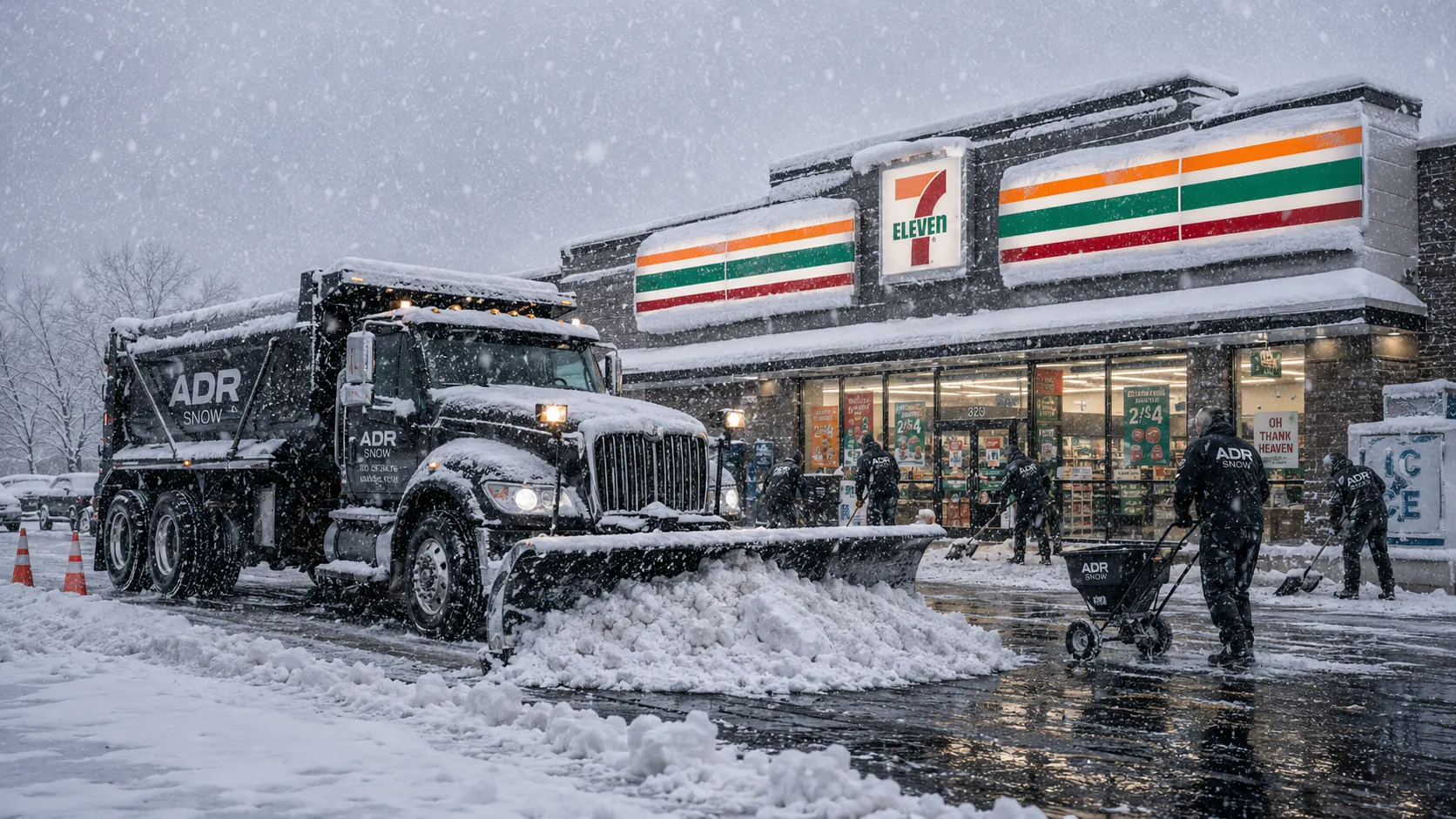

In practice, the terms de-icing and salting overlap. In the commercial snow contract, they are distinct workstreams. Understanding the distinction helps property managers scope their contracts and evaluate what the vendor is actually delivering.
Salting as a default
Salting refers to the application of granular rock salt or treated salt blends to pavement and walkways after plowing or shoveling. The salt lowers the freezing point of any remaining moisture, preventing it from refreezing into ice. This is the default closing-pass treatment on every commercial event.
Salting works best between roughly 15 and 32 degrees Fahrenheit. Below that range, plain rock salt loses effectiveness and requires either treated blends or a different chemistry to remain active.
De-icing as a broader category
De-icing covers the broader operational category of preventing or removing ice formation. It includes salting but also includes liquid brine pre-treatment before forecast events, calcium chloride or magnesium chloride applications at lower temperatures, and specialty chemistries for environmentally sensitive sites.
On a commercial property, de-icing runs on multiple cycles. Pre-storm, during the storm, immediately post-storm, and through cold-weather periods between storms when freeze-thaw or refreeze conditions create ice risk without accumulation.
When to use which
A well-scoped commercial contract typically uses brine pre-treatment before forecast events, traditional salt for the closing pass on each event, and either treated salt or chloride blends for cold-weather periods below the salt-effective temperature. The combination is what keeps the property safe across the full range of winter conditions.
Operational note
ADR Snow Management runs commercial winter operations across New York, New Jersey, Connecticut and Massachusetts. If your property would benefit from a contract structured around the standards described above, the conversation starts with a callback.